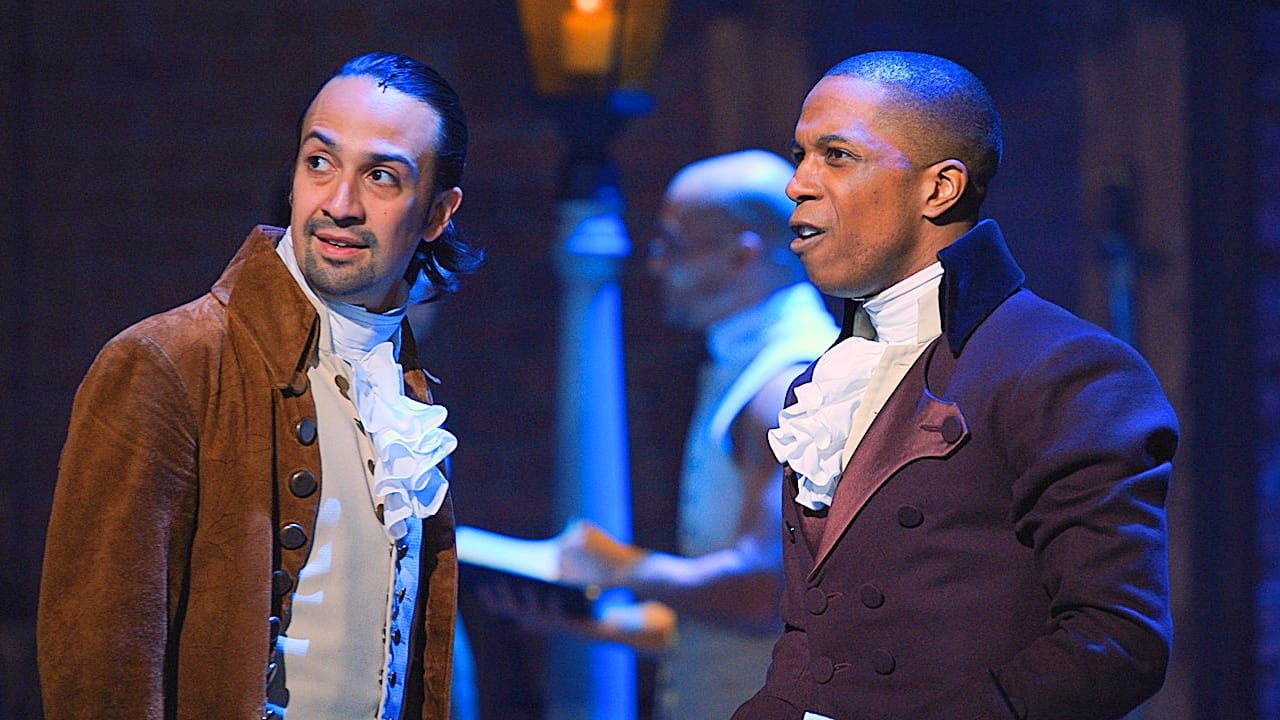
The first time the world heard what would eventually become Hamilton was at the White House on May 12, 2009. The definitive record of that original cast’s time on Broadway debuted in 2020 but it was filmed ten years ago in 2016. When the show opened it captured the zeitgeist and even made Gen Z optimistic about the American idea. Just three months after most of that original cast left the show, Donald Trump won his first Presidential election. Lin Manuel Miranda’s masterpiece remains popular on Broadway and on an active world tour, yet its legacy is complicated.
In this same ten-year span, Miranda became a kind of pop culture darling only to ride the trajectory of fame to the point where he “sucks, actually.” Truthfully, I am not really qualified to review a Broadway-style musical. In my entire life, I’ve seen less than a dozen in full (counting the three I stage-managed in high school). Of those, I only enjoy Hamilton, and that’s less about its substance and more about my personal relationship with it. In 2016, I was till a full-time reporter and political analyst caught up in the most fraught and emotionally draining election in history. I only became aware of Hamilton through my son, and its through sharing the musical with him that it maintains a place of deep affection in my heart.
The Hamilton Phenomenon (Localized To One Family In Pittsburgh, PA)

To explain why I love Hamilton, I should first turn to another ten-year-old bit of media, Patton Oswalt’s January appearance on Conan. In this interview, he describes an experience that I had some years earlier. He talks about introducing his kid to Star Wars, only for her to not care for it. He then described her affection for My Little Pony: Friendship is Magic (which my son loved as a kid) as comparable to how he (and I) felt about Star Wars. The joke was that he didn’t know anything about that show only to detail the intricate mythology. The point is that instead of forcing our fandoms on our kids, we should share their obsessions with them.
Along with sci-fi and fantasy, men of a certain age often have a historical war they obsess over. For some it’s the conflicts of the Roman Empire, for many others it’s World War II. Understanding and explaining American politics was the center of my career. So, for me, it was the two domestic US wars, and their effect on the US Constitution. So, when my son told me about Hamilton, I already had a head start on this obsession. It was a show made richer with one’s understanding the history of the American revolution and hip-hop. I’d already read Ron Chernow’s Hamilton biography, and I was able to single out almost every hip-hop homage.
When I interviewed Cupertino‘s Nik Dodani, he mentioned his excitement to work with Renee Elise Goldsberry because she was Angelica Schuyler. It put some Hamilton songs in my head, and like one does to clear out an earworm, I listened to them. It was probably the first time I’d done so since watching the Hamilton movie on Disney+ with my son and mother when it debuted. It hit me with such a powerful wave of nostalgia. Hamilton dominated my time with kid, essentially my only joyful times in what was a terrible year personally, professionally, and for the future of the American experiment.
Hamilton Celebrates American History Without A Lot Of Accuracy
As a historical adaptation, Hamilton is a prime example of how “accuracy” does not equal “truth.” Most people’s experience with history involves Social Studies lessons that culminated in exams with rote recitation of dates and other facts. So, they don’t realize that history is a lot like literature in that it’s all based on things written down, some recently and some centuries ago, that are open to multiple interpretations. Hamilton doesn’t even qualify as this, despite using Chernow’s book as its inspiration. It omits many important facts and some events are wholly misrepresented.
For example, the show suggests Hamilton wrote the infamous “Reynolds Pamphlet” as a pre-emptive strike against allegations of financial impropriety (instead of just regular degular impropriety). In reality, it was a response to pamphlets by James Thomson Callendar which incorrectly tied his affair to illegal financial speculation using Treasury funds. Interestingly, Callendar’s writings also almost led to a duel between Hamilton and James Monroe, a Founding Father most famous for his eponymous anti-colonialist doctrine. It was averted, ironically, by Aaron Burr (sir).
There are countless other inaccuracies, omissions, and other uses of poetic license. The show maintains that New York is where most of its events unfolded, but Hamilton and the rest of the government moved to Philadelphia for the decade before the District of Columbia became the capital of the US. Even the one point in the show when Miranda breaks the fourth wall to assert the veracity of a claim is false. He says Martha Washington named a “feral tomcat” after him because of womanizing reputation. Not only is this almost certain not true, the use of “tomcat” to describe a promiscuous man wasn’t even a thing until the 1920s.
Yet one should not turn to a Broadway musical for historical facts. What Hamilton does capture is one, positive-but-sincere view of both its subject and the potential of the imperfect system he helped build. This is partly what’s contributed to the recent backlash against the musical, which is fair considering how stunningly the past decade exposed its flaws. Sure, the stage is a place where an interrogation of our national flaws can unfold. That’s just not what Hamilton is supposed to be about. At the end of the Obama era, the culture was ready to embrace the aspirational nature of what America can achieve when people of principle try to make the world a better place. In 2026, with Trump back in office and every aspect of American life on fire, it’s understandable that people are less receptive to such a message.
Most Of The World Didn’t Get To Experience Hamilton Before the Disney+ Movie

My son and I primarily listened to the cast album, but there was also a bootleg video of the play my son watched. I discovered it when snooping through his internet history and startlingly found a popular porn video site. I didn’t mean to click the link, but I panicked and the page loaded showing a video titled: “Founding Fathers Get Freaky In The Bedroom.” It also appeared under other titles like “Revolutionary Twinks Have Historical Fun” and, my personal favorite, “Alexander Hamilton Fucks Whole British Army.” While, on general principle, I loathe piracy, I couldn’t even be mad.
One of the best parts about engaging with narrative art is that one can enjoy it as entertainment and digging below the surface to find some measure of meaning, intentional or otherwise. That’s essentially the mission statement of Fandom Rising, after all. As a mirror to the current moment, Hamilton‘s deeper message hasn’t aged all that well. It’s still, in one non-musical fan’s opinion, a great musical. Like Fox Mulder, I also want to believe that its message can still apply to the real world, even after a decade of America throwing away every possible shot it had to rise to the moment. Nonetheless, I will forever treasure what Lin Manuel Miranda created with the help of his collaborator Alex Lacamoire because of what I was able to share with my son. Hopefully, there’s still time to make it right for him. Someday.
Hamilton is currently playing at the Rogers Theatre on Broadway and touring the world, while the original cast album is available wherever you get your music, and the film streams on Disney+.


