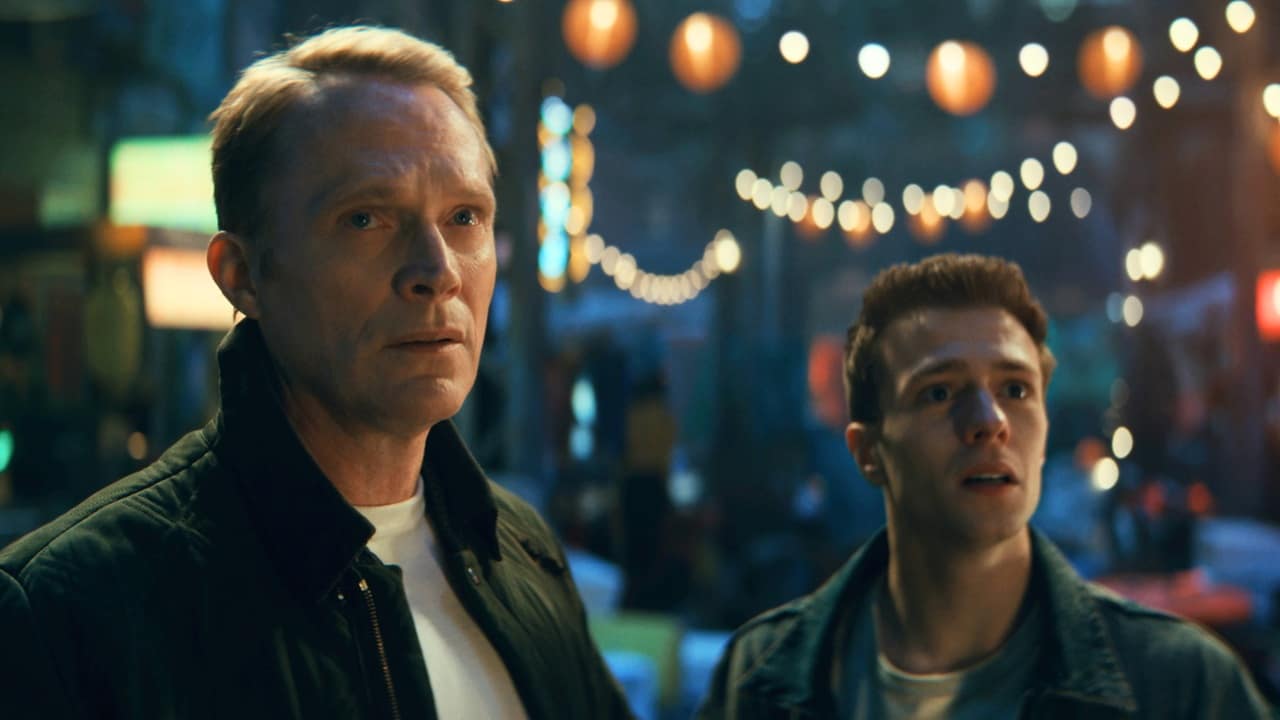
The following contains spoilers from VisionQuest Episodes 1 & 2 which debuted October 13, 2026, on Disney+.
The new show VisionQuest serves as the third leg of a “trilogy” that began with the first Marvel Studios series to debut on Disney+, WandaVision. However, the connection that London foster kid Thomas Shephard has with the Vision is explained in the middle chapter, Agatha All Along. Of the many questions these characters are seeking answers for, “how” this happened is not one of them.
Inspired by similar stories in Marvel Comics, WandaVision introduced the children of Vision and Wanda. The rub is that Wanda created her entire family out of thin air using her “chaos magic.” Vision died in Avengers: Infinity War, but his body was recreated into the version of the character in VisionQuest. Yet, when the “Hex” fell, the souls of Wanda’s sons Billy and Tommy did not vanish. Agatha All Along explained what happened to them, and it’s darkly tragic. So, while Vision and Thomas may not care about the mechanics of this resurrection, viewers might.
Agatha All Along Is the WandaVision Trilogy’s Odd Show Out

If VisionQuest is the trilogy’s emotional destination and WandaVision is its foundation, then Agatha All Along is the strange sidquest in the middle. It’s campy, a little spooky, a little bit of a musical, and an interesting bit of magical MCU worldbuilding. It follows Kathryn Hahn’s Agatha Harkness after she was trapped in a spell by Wanda. The middle series opens with a character played by Joe Locke and only identified as “Teen” until the seventh episode. He frees her from Wanda’s spell, helps her gather a coven, and they perform a ritual to enter “the Witches Road.”
Except that last bit is a long con which Agatha ran for centuries to murder other witches for their magic. So, no one is more surprised than her when she and her coven end up there. This is because Teen is actually a reincarnated Billy Maximoff, and like his mother his deep emotional yearning manifested a magical reality with its own rules outside of the caster’s control. Only the most dedicated MCU fan would likely watch this show for lore reasons, but it is a worthy successor to WandaVision. It’s weird and funny and introduces some interesting concepts in general.
Yet, its main function is to explain how Billy Maximoff is alive. When the Hex collapsed, Billy’s soul didn’t vanish. It found a vessel in William Kaplan, a teenager who died in a car crash as Westview’s magic fell. Tommy wasn’t so lucky. His soul drifted. In the finale, Agatha helped Billy find his brother’s soul and place it in the body of a boy who’d been drowned in a cruel prank. Billy doesn’t come to understand all this until he frees Agatha from his mother’s spell, survives the Witches’ Road he created, and helps Agatha in a duel to the death with Death herself as Wiccan, the Young Avenger.
VisionQuest Picks Up Tommy’s Story From Where Agatha All Along Left Off
The scene in which Billy saves his brother’s soul is vague and ethereal, because Ruarid Mollica was not yet cast. Still, that show ends with Billy and Agatha (now a ghost, because comics are silly and cool) go off to hunt for him. Unlike his twin, Tommy has not forgotten his life as Thomas Shephard. So instead of living as an imposter in his own skin like Billy, Tommy bears the burden of two sets of memories from two lives. The reason these magical mechanics are different is not MCU lore inconsistency, it’s thematic. Put another way: Like father, like son.
The central conflict in VisionQuest is not the battle with Todd Stashwick’s Paladin nor the looming clash with T’Nia Miller’s Jocasta. (In the comics, she’s a robot created by Ultron as his bride. In the MCU she is a name on a data stick in the background when Tony Stark uploads a new AI assistant called FRIDAY — played in this series by Orla Brady — after JARVIS evolved into Vision.) Rather the central conflict in VisionQuest is one of identity. Vision also came back from the dead, so to speak, and while he has the memories of his predecessor, he does not consider himself to be the same “person.”
The first two episodes show that Vision refuses to even study the memories of his counterpart’s time in the Hex with Wanda. He doesn’t consider any of that “real,” since it was all the creation of the Scarlet Witch. Thus, he does not consider Thomas Shephard’s claim that Tommy’s memories are in his head valid. Nonetheless, he feels compelled to save the boy from Paladin. The question viewers should ask isn’t tied to “how?” it’s “why?” Does Vision feel a paternal connection with this boy, or is he just doing what the thinks his predecessor, a real “hero,” would do?
MCU Canon Is Fun Lore For Nerds, But It’s Also Metaphor To Make Stories More Powerful

The mechanics of Tommy’s resurrection matters just as much as the mechanics of how Hex Vision transferred his memories to White Vision with just a touch. The lore specifics don’t really matter. It’s all so much sci-fi or fantasy hand-waving. Nobody demands a physics paper on how Captain America’s shield ricochets off six targets and returns to his hand. The important thing is that Cap goes into battle armed only with something designed to defend, to protect. The same is true for the Hulk, whose gamma-induced transformation is a commentary on how humans’ most negative emotion can be either destructive or, applied correctly, heroic.
Looking over the VisionQuest reviews, those who rated the series poorly often point to the way Terry Matalas and company drew on past MCU moments for their story. To them, they see the kind of Easter egg hunt that only diehard fans enjoy. In a way, they’re right, because Matalas had to be a “real fan” to use so many disparate, tiny moments as building blocks for this story. But because they believe it’s so much commercial nonsense, they dismiss the MCU of it all out of hand instead of thinking critically. What makes VisionQest genius is how those elements serve the larger story.
This is why VisionQuest never bothers to explore how Tommy came back to life. Thomas and Vision not having the answers is the point. Nobody who loses someone gets a tidy briefing on what happened and why. They get fragments, memories that don’t fit together, and strong emotions they cannot articulate aloud. A show that explained everything in a neat flashback would feel less honest about that experience, not more. It would be the kind of soulless canon dump some claim the rest of VisionQuest‘s confluence with the MCU already is.
The Real Magic Of VisionQuest And The MCU Isn’t In The Mechanics But The Meaning

When critics or even casual viewers identify details in one MCU story that tie to a previous one, they often dismiss them as a kind of corporate vertical integration in the narrative. This is not a failure on the part of the storytellers. Rather, it’s reflective of their own lack of imagination. They think it’s meaningless, something underserving of the intellectual rigor given to “High Art.” Yet just, like Vision’s and Tommy’s understanding of their identities or connection, their refusal to look deeper doesn’t mean it lacks depth.
Tommy came back to life because his magically powerful twin cast a spell to place their souls into the bodies of two kids who died at the same moment they disappeared from Wanda Maximoff’s Hex. The storytellers can make up any manner of fantasy specifics about how that happened. But if those details don’t matter to the characters for some personal, emotional reason, they have no place in the story. Agatha All Along examined these mechanics because it mattered to Billy. He was the one who did it, and understanding this was crucial to his emotional journey.
Vision and Tommy are on a different path. They aren’t traveling the Witches’ Road, but instead travel one that leads to self-discovery and acceptance. So long as VisionQuest delivers on that, it’s done its job. For the viewers who can’t bear that kind of unanswered question, there’s articles like this. But this further proves my point. Because recounting the MCU lore this way is no match for the experience of discovery one gets by watching Agatha All Along for how this truth changes the characters themselves.
VisionQuest drops new episodes on Wednesday nights on Disney+, streaming alongside the complete WandaVision and Agatha All Along series.


