
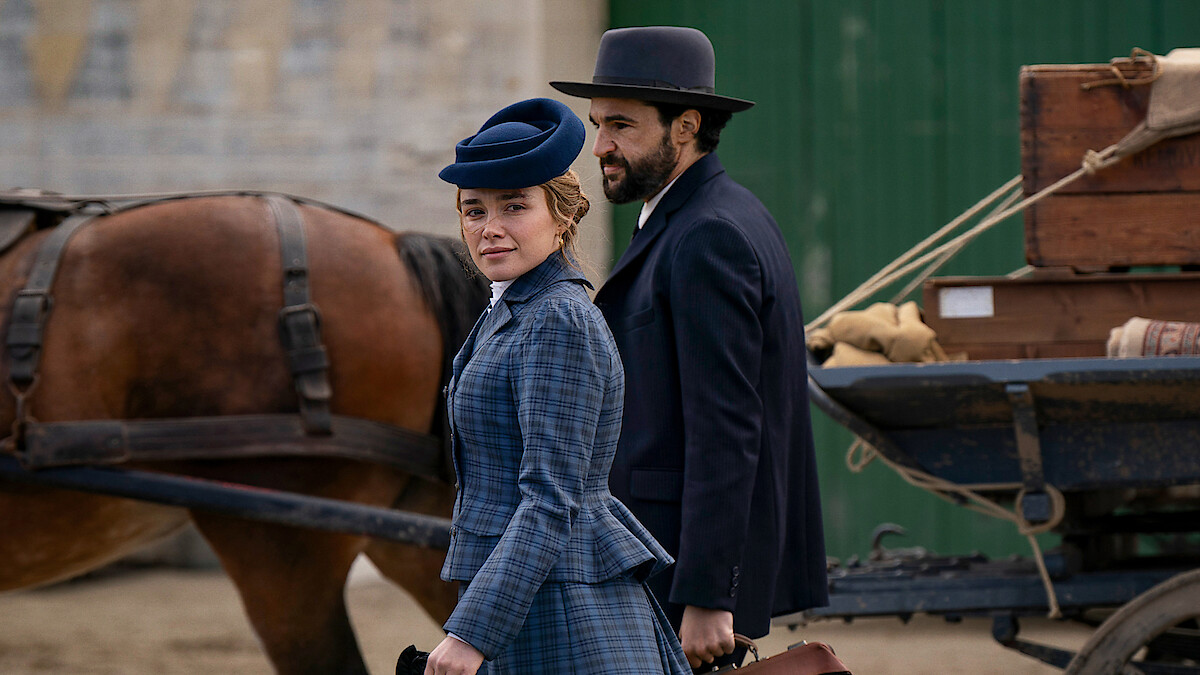
The new East of Eden Netflix series introduces a whole new audience to Cathy Ames, played by Florence Pugh. For years, Cathy served a singular role in the novel’s plot and readers’ discussion, as the epitome of evil itself. The new show aims to deepen our understanding of the character. In part, writer, co-showrunner, and executive producer Zoe Kazan decides to spend more time exploring the “why” of Cathy’s heartlessness. Like the newest Carrie adaptation, it adds complexity to a decidedly complex person. As a lover of the John Steinbeck novel, I think the show takes liberties it’s allowed to take, but still holds the core of each main character. In particular, the East of Eden Netflix series does a good job of showing one element of Cathy that’s misunderstood and deserves more weight when deciding just how wicked she truly is.
Cathy is at the Center of the East of Eden Netflix Series, and It Gives Needed Attention to this Part of her Story

Story spoilers for East of Eden are included in the article below. Exercise caution if you’re wanting to avoid spoilers.
East of Eden is the story of two brothers, Adam and Charles, whose fateful meeting of Cathy changes the trajectory of their lives. The way their father shaped their lives has deeply affected their worldview. Adam is docile and struggles to identify malice in people around him, while Charles has violent, rageful tendencies. Free will, or rather the way both men exercise it throughout their lives, drives this multigenerational tale. When Cathy enters the picture, she becomes the catalyst that exposes both men’s deepest flaws.
In the novel and subsequent discussion of Steinbeck’s work, Cathy is often seen as bad or evil incarnate. The decisions she makes in the narrative are categorically immoral and harmful, often resulting in the death or destruction of others who hold her to be a loved one. Still, my overwhelming impression on my first reading was that Cathy wasn’t pure evil, but someone unwilling to let her life be written for her. The show does a great job of explaining why it’s not evil for evil’s sake.
When Cathy enters Adam’s life, she’s been beaten nearly to death by her partner. Despite her harmful choices, she enters Adam’s life powerless and in need of help. Her recovery requires Adam’s constant care while she remains bedridden. In short, she doesn’t have the freedom to act on her own will. Good intentions aside, Adam begins deciding Cathy’s future for her. This is the latest violation in a series of people seeking to control her.
Cathy’s Rejection of the Life Women Were Expected to Live Leads to Her Extreme Reaction and Path of Destruction

For women in the late-19th and early 20th centuries, agency was a non-starter. Fathers passed their daughters to husbands, seeing them as objects and property rather than partners. Cathy’s character, from a young age, does very extreme things, but it’s all in the name of disallowing others, mainly men, to decide her life for her. A male teacher she seduces says they’ll marry, so she ruins him. Her father, who beats her and fails to believe her about the trauma she experienced as a young child, must be removed from her life to obtain the freedom she seeks. Her onslaught isn’t directed only at men. Faye, the madam of the brothel Cathy moves into in Salinas, or her own mother, proves that. The fact of the matter is if someone in life was attempting to control a woman, it was likely going to be a man.
Her rejection of that control, however brutal in how she carries it out, is worth exploring, and the show gives her character the space to do so. The question is less about a gendered vendetta and more about East of Eden’s central resource: free will. Timshel, the Hebrew word for “thou mayest,” plays a huge role in Adam’s realization that his post-Cathy life is his to shape. He passes this lesson to his son Cal at the pinnacle of East of Eden. Cathy doesn’t feel that she has much of a say in life without this brutality she’s adopted. Her flaw isn’t an inherent evil, but a belief that the evil around her must be met equally. Is she wrong, beyond a moral sense? She doesn’t think so.
For Viewers of the Netflix Series Today, A Deeper Debate Emerges Around Cathy’s Actions
The East of Eden Netflix series shows that this timeless story is more than good versus evil. It’s a question of whether or not the circumstances of one’s life dictate it. For Cathy, the lack of agency she’s given becomes an opening for no mercy. To modern viewers, particularly through the feminist lens the show equips, Cathy becomes a much more compelling character than just a tyrannical evil-doer. Like any good morality debate, we can argue about justification and whether the ends justify the means. The show makes that argument a bit more elastic, and helps to push back against the “evil woman” trope history has applied to Cathy.
East of Eden is available now and streaming on Netflix.


2 Comments on “East of Eden Netflix Series Nails This Element of Cathy”