“Patient Zero,” “Pink Clouding,” “Cleveland!” and “Babylon” were written after Taylor Swift had already lived with The Life of a Showgirl for another year. Together, they sound less like bonus tracks than what happens when you finally have enough distance to understand the life you were writing about.
Taylor Swift didn’t need to add anything to The Life of a Showgirl. A year after its release, the album is still a massive success. But when Swift traveled to Sweden to celebrate with Max Martin and Shellback, the longtime producers and songwriters behind some of her biggest hits, there happened to be a studio nearby. As Swift explained when she announced The Encore, the three collaborators had planned to spend the trip reflecting on the album’s success and how grateful they were for it. Instead, as Swift put it, “there was a studio there and we did what we do when we feel anything at all: We wrote more songs.”
That timing may be the key to understanding The Life of a Showgirl: The Encore. “Patient Zero,” “Pink Clouding,” “Cleveland!” and “Babylon” weren’t simply four missing pieces from the original album, even if, on first listen, they seem almost totally disconnected.
But this is Taylor Swift.
The four songs were written after The Life of a Showgirl had already become a record-breaking success. And together, they sound like Taylor looking at the life she already wrote about one year later: recognizing what someone did to her, confronting what she did to somebody else, appreciating what she has now, and wondering whether we ever recognize our own Babylon before it’s gone.
“Patient Zero” Turns Taylor Swift’s Hindsight Into a Gothic Ghost Story
The “Patient Zero” music video made its world premiere during the 2026 MTV Video Music Awards on September 27, shortly after Swift received the inaugural MTV VMA Artist Director Honors, an award recognizing artists whose work behind the camera has advanced music-video storytelling.
Swift wrote and directed the video herself. Emmanuel “Chivo” Lubezki, the three-time Academy Award-winning cinematographer behind Gravity, Birdman and The Revenant, served as cinematographer, while longtime Swift collaborators Ethan Tobman and Chancler Haynes handled production design and editing.
The idea behind “Patient Zero” is deceptively simple: what happens when the woman who came before you stops being competition and becomes the one person who understands exactly what you’re going through?
The song turns that idea into an extended disease metaphor. Taylor casts herself as the first identifiable case—the woman who has already survived the symptoms and recognizes them when another woman starts getting sick. She isn’t warning her replacement because she wants the man back.
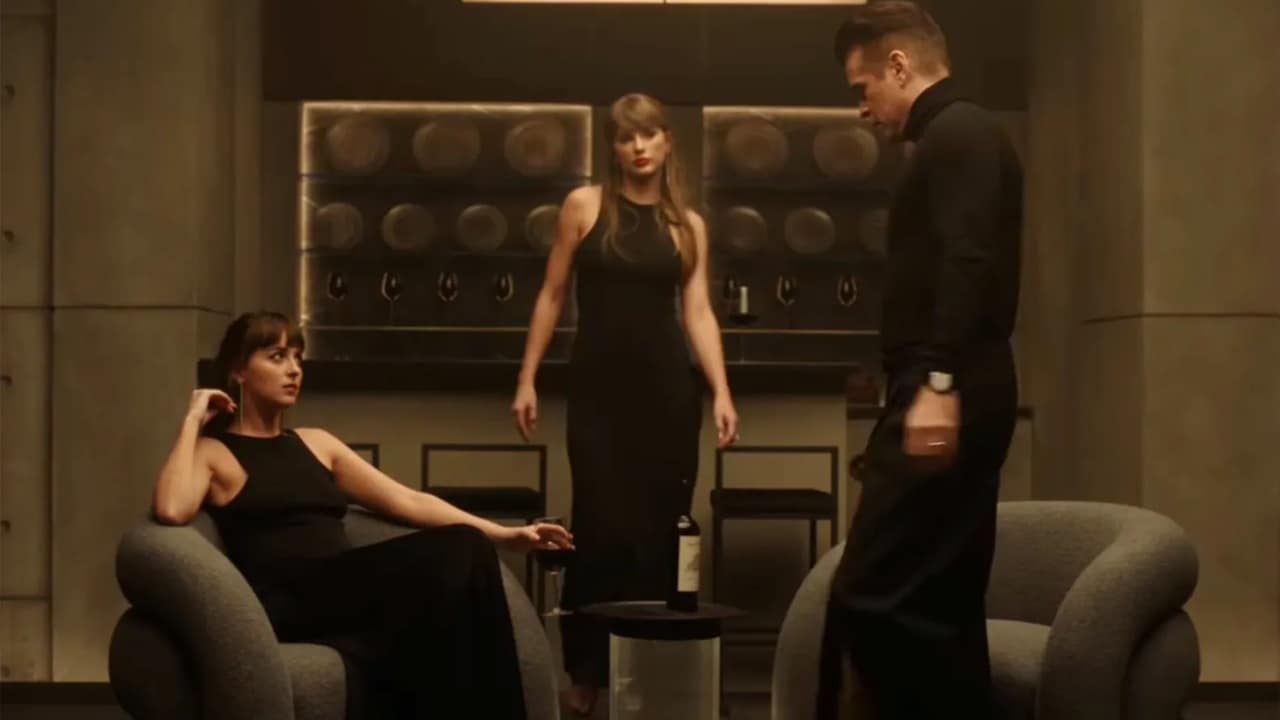
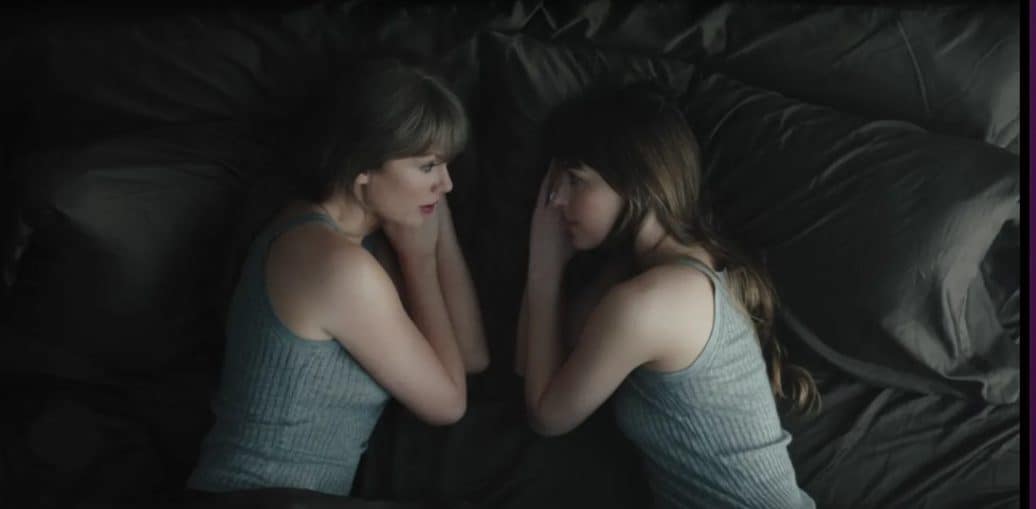
She knows what comes next. Then Taylor made that metaphor literal. The video stars Dakota Johnson and Colin Farrell as a wealthy married couple whose seemingly beautiful life inside an enormous home gradually becomes something much darker. Johnson’s character is becoming sick. Farrell’s husband gaslights her as their marriage deteriorates. Cara Delevingne appears as another woman orbiting him. And Taylor keeps appearing around Johnson like a ghost—watching her, mirroring her and seemingly inserting herself into their marriage.
Until we find out why. Taylor isn’t the other woman. She’s the dead first wife. The video eventually reveals an old newspaper story about the death of an heiress, explaining Taylor’s seemingly impossible presence throughout Johnson and Farrell’s marriage. Flashbacks reveal that Taylor once occupied Johnson’s place in the same relationship—and that Farrell’s character poisoned her.
Suddenly, the matching clothes, mirrored images and repeated spaces stop looking like Easter eggs and start looking like evidence. Johnson isn’t imagining Taylor. She’s repeating her life. And Taylor isn’t haunting her. She’s trying to get her out. That makes the relationship between the two women considerably more interesting than the usual ex-versus-new-girlfriend story. The woman who came before isn’t competition. She’s the only witness who understands what’s happening because it already happened to her.
And unlike plenty of Taylor Swift music-video theories, we don’t have to build this one entirely out of red-string evidence boards. After the VMAs premiere, Swift explained some of the visual influences behind “Patient Zero”, describing a mixture of gothic ghost stories, true crime and psychological thrillers. She also explained that the enormous house was intended as a metaphor for the coldness of a relationship that had faded and atrophied.Then she gave us considerably more.
Taylor Swift’s “Patient Zero” BTS Makes the Story Even Clearer
On October 3, Swift released the official eight-minute “Patient Zero (Expanded Video)” on Apple Music, combining the finished music video with behind-the-scenes footage from the shoot. Instead of simply showing us how the video was made, the footage gives Swift a chance to explain the story she was trying to tell—and makes some of its darker implications considerably less ambiguous.
“I’ve been wanting to make this video my entire life,” Swift says at the beginning. Her description of the concept helps explain why the finished film reveals its story so gradually. She wanted the audience to enter a sleek, controlled world without immediately understanding what was wrong with the people living inside it. It’s a ghost story, a true-crime story and a psychological thriller happening at the same time.
Swift gets considerably less subtle when discussing Farrell’s character. In the expanded behind-the-scenes video, she calls him an “absolute malignant narcissist” and a “psychopath,” while praising Farrell himself for being willing to explore the darker edges of the character. So, for once, we don’t need a 46-post Swiftie thread to determine whether the husband is supposed to be dangerous. Yes. Yes, he is. The expanded footage also makes “Patient Zero” more interesting as a piece of Swift’s directing work. We see her working through scenes with Johnson and Farrell, collaborating with the crew and responding to tiny details in the actors’ performances. During one take, Johnson executes a fall without spilling the glass of wine in her hand, which Swift reacts to like she has just witnessed an Olympic event. And then there’s the dinner fight.
In the finished video, Johnson and Farrell scream across the table during one of the ugliest moments in their marriage. Watching it without context, you’d reasonably assume they’re fighting about infidelity, manipulation or the fact that this man may eventually try to murder her. No. They’re arguing about Brendan Fraser. The behind-the-scenes footage reveals that Johnson insists Brendan Fraser played Tarzan. Farrell keeps correcting her: it was George of the Jungle. Farrell is correct. Swift describes it as essentially the dumbest fight imaginable. And the entire thing is hilarious with the music removed. Thank you, once again, for delivering us more amazing content, Taylor. Also, Colin was correct, sorry Dakota.
It’s funny BTS trivia, but it’s also a pretty fantastic demonstration of what the finished video is doing. We don’t hear George of the Jungle and laugh while watching that scene. We see a frightening marriage. The menace comes from Johnson and Farrell’s performances, Lubezki’s cinematography, Tobman’s production design, Haynes’ editing and Swift’s direction. The song gave Taylor enough distance to recognize the pattern. The video lets her walk back into the house and show us exactly what she sees now.
“Pink Clouding” Makes Taylor Look at the Person She Hurt
If The Encore were only about hindsight exposing people who hurt Taylor Swift, “Patient Zero” would make that argument pretty easy. Then “Pink Clouding” makes everything messier. The title borrows from “pink clouding,” a term associated with the euphoric early stages of addiction recovery, when someone can experience unusually intense optimism, confidence and excitement about recovery. Taylor isn’t equating a breakup with addiction recovery. She’s borrowing the idea of a temporary emotional high as a relationship metaphor. And this time, Taylor isn’t the person who gets hurt. She’s the person apologizing.
As the Associated Press noted in its breakdown of the four new songs, “Pink Clouding” has Swift looking backward at a relationship in which she led someone on and apologizing years later for the damage she may have caused. The narrator entered something new while still carrying damage from what came before it. She believed she was fine—or at least desperately wanted to be—and got swept up in the emotional high of something new. Then the cloud cleared. The song’s color imagery reinforces that progression. Magenta. Fuchsia. Rosewood. Crimson. Gray. Pink. Taylor turns a color palette into an emotional timeline: the overwhelming saturation of something new gradually giving way to what was actually underneath it.
There has already been speculation that the song could be about Tom Hiddleston, whom Swift dated briefly in 2016 following her breakup with Calvin Harris. But even coverage exploring that possibility acknowledges that Swift hasn’t identified the song’s subject. And solving his identity is probably the least interesting thing Taylor is doing here anyway. Taylor Swift has written plenty of songs explaining, in exquisite detail, what somebody else did wrong. “Pink Clouding” asks her to look backward and admit that this time, she was somebody else’s difficult chapter. Being hurt explains behavior. It doesn’t erase its impact. That’s a much less comfortable use of hindsight than “Patient Zero,” and that’s exactly why these songs become more interesting together.
“Cleveland!” Is Taylor Swift Recognizing What She Has While She Still Has It
Then Taylor stops looking backward. As The Washington Post noted in its breakdown of “Cleveland!”, the song opens by running through the kind of criticism Swift has received for years—her looks, her clothes, her dancing, her authenticity and even whether she’s enough of a “girl’s girl.” Her solution is almost comically modest. Find one person in the entire world who doesn’t find you completely insufferable. She found hers. How does Taylor Swift know the bar is this low? The Cleveland of the title isn’t arbitrary. Travis Kelce, Swift’s husband and Kansas City Chiefs tight end, grew up in Cleveland Heights, Ohio, and the song connects him directly to “The Heights.” Both The Washington Post and the Associated Press read the song as an ode to their relationship.
But reducing “Cleveland!” to the Travis Song misses the more interesting shift. Taylor has been writing about public criticism forever. “Mean,” “Shake It Off” and “Look What You Made Me Do” all respond, in very different ways, to people judging, mocking or defining her from the outside. “Shake It Off” was Taylor telling everyone—and maybe herself—that the noise didn’t matter. “Cleveland!” doesn’t need to convince us. The song’s answer to being discussed by millions of strangers is essentially: the person who actually knows me likes me just fine. There’s a difference between trying not to care what people think and finally deciding whose opinions deserve to matter.
That makes “Cleveland!” the present tense of The Encore. “Patient Zero” required distance to understand what somebody did to her. “Pink Clouding” required distance to understand what she did to somebody else. “Cleveland!” asks whether it’s possible to recognize the good thing before hindsight has to do the work for you. And then “Babylon” shows exactly why that matters.
“Babylon” Reveals What The Encore Is Actually Warning About
At first, “Babylon” sounds like a song about losing something magnificent. It’s worse than that. As the Associated Press describes it, “Babylon” tells the story of a relationship destroyed because its subject keeps chasing whatever comes next instead of valuing what he already has. The song follows someone who leaves behind the ordinary pieces of one life while chasing something bigger—more freedom, more money, more possibility—only to look backward and finally understand the value of what he abandoned. ELLE similarly interprets the character as a man who leaves his hometown, partner and family behind while pursuing a wealthier and supposedly freer life.
Only later does he recognize what it was. Babylon. The name itself carries centuries of cultural baggage. Babylon has long functioned in music and culture as a metaphor encompassing magnificence and wealth as well as excess, corruption, destruction and loss. Taylor’s use of it doesn’t require a theology seminar. Here, Babylon is the paradise you don’t recognize until you’ve left it. And Taylor doesn’t let her character learn the obvious lesson. He’s still looking backward. By the end of the song, he’s physically present in his current life but mentally somewhere else, sitting in his car at bedtime and romanticizing what he lost. He finally recognizes the first Babylon—and, in obsessing over it, risks failing to recognize the next one.
That’s the part that turns “Babylon” from another song about regret into the song that makes The Encore click. “Patient Zero” says hindsight can reveal the pattern. “Pink Clouding” says hindsight can force accountability. “Cleveland!” says maybe happiness can be recognized while it’s happening. And “Babylon” warns that looking backward can become just as destructive as refusing to look backward at all. Taylor Swift wrote The Life of a Showgirl from inside one period of her life. Then another year passed. She returned to Sweden with Max Martin and Shellback and four more songs came out of a trip that wasn’t originally supposed to be another recording session at all.
The events she was writing about may not have changed. Her position in relation to them did. That’s why The Encore doesn’t feel like the missing second half of The Life of a Showgirl. It’s Taylor Swift looking back at that life from the other side. The show is over. The lights are back on. Now she can finally see the room.
The Life of a Showgirl: The Encore is available now through Taylor Swift’s official Apple Music page. The official “Patient Zero” music video is also available now, along with the official eight-minute “Patient Zero (Expanded Video)”, featuring behind-the-scenes footage from the shoot.


