THIS CONTAINS SPOILERS TO ALL THREE OF THE ORIGINAL HUNGER GAMES BOOKS, SUNRISE ON THE REAPING, AND A BALLAD OF SONGBIRDS AND SNAKES!
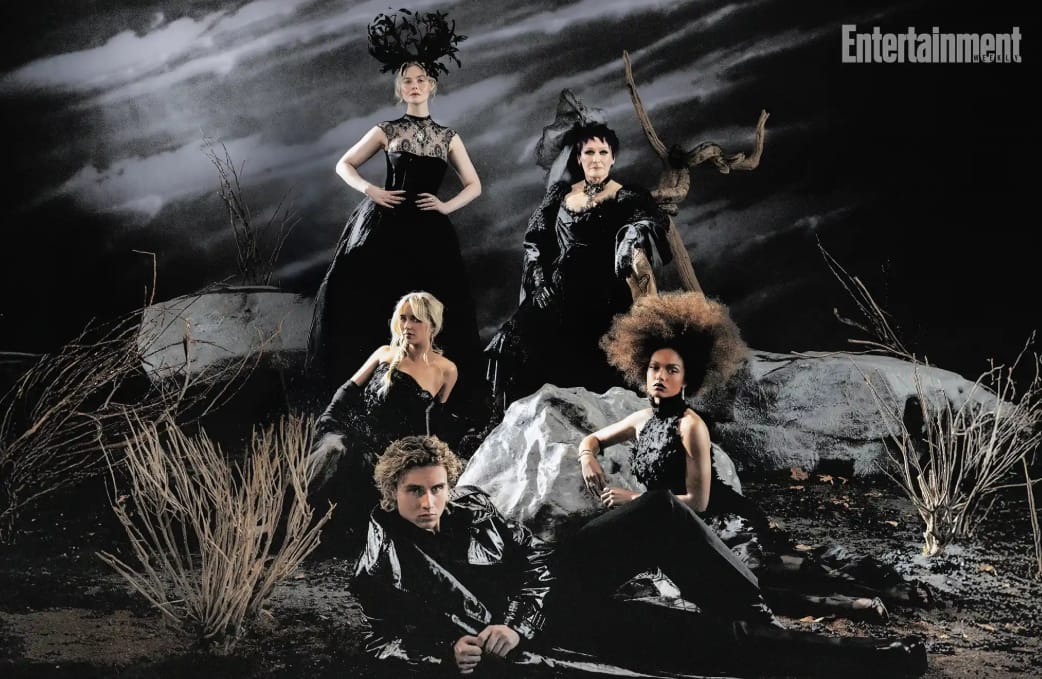
Entertainment Weekly just released a new cover story on The Hunger Games: Sunrise on the Reaping, along with a new batch of images that give us our best look yet at the 50th Hunger Games — not just Haymitch, but the people standing beside him. Joseph Zada is front and center, obviously… he is Haymitch, and we’re finally meeting him and learning why he became the man he is in the original trilogy, the version that mentors Katniss and Peeta after self-isolating and self-medicating, by choice (somewhat), for 24 years.
But we already know this from my last article, so what I’m especially excited about in these new images is everyone standing around him.
Because we’re not just meeting Haymitch. We’re meeting the 48 Tributes from the Second Quarter Quell, arguably one of the cruelest, bloodiest Games in Panem’s history.
And we haven’t really done that before, just like we never really met Haymitch before now.
We’ve met VICTORS. Notice I didn’t say TRIBUTES. Catching Fire introduced us to Finnick, Johanna, Beetee, Wiress, Mags, Enobaria, and a whole group of people who had already survived their Games. But outside of Rue, Cato, Thresh, and a handful of others, how many of Katniss and Peeta’s actual fellow Tributes did we ever really know? Even the ones we remember are mostly surface character stuff because Katniss doesn’t know them either.
Which is kind of interesting when you think about how deliberately the Capitol isolates the Districts from knowing anything about one another. They aren’t supposed to know each other. Knowing people makes them harder to hate, and it makes watching them die a lot less fun for the Capitol citizens.

That matters because the Second Quarter Quell is not just “Haymitch’s Hunger Games.” It is the Games where the Capitol takes four children from every district instead of two, doubling the field to 48 Tributes. EW’s new cover story gives us clearer looks at several of those kids and starts to separate them from the mass of bodies the Capitol forces them to become.
 Tributes compete in ‘The Hunger Games: Sunrise on the Reaping’.Lionsgate
The newest images keep bringing me back to one of the nastiest things Suzanne Collins does in the book:
The Capitol doesn’t even need the actual child anymore. It just needs the role filled for THE SHOW the Games have turned into. You have to have your circus, right?
Louella & Lou Lou: The Show Must Go On
Louella McCoy may be the clearest example. Francis Lawrence describes her to Entertainment Weekly as “so small and young” and emotionally important to Haymitch, and says they deliberately cast Molly McCann to resemble a young Katniss. (Entertainment Weekly)
That resemblance matters, because Haymitch calls Louella “sweetheart.”
Twenty-four years later, another District 12 girl with dark hair and a braid walks into his life, and Haymitch calls her “sweetheart,” too.
How much of Haymitch is standing there looking at Katniss in that moment, and how much of him has been mentally thrown back into his own Games? He already has to relive the worst period of his life every year as a mentor, watching District 12 send him another boy and another girl who are almost certainly going to die. Then Katniss and Peeta show up, and Haymitch manages to do something no one expects: he keeps both of his Tributes alive.
After surviving a Quarter Quell where the other 47 children die, Haymitch becomes the mentor who brings home two.
That makes Louella more than an explanation for a nickname. She is one of the children still living inside the adult Haymitch we thought we knew.

What happens to Louella is even sadder (although she does avoid the Arena, but I’m not sure that’s a silver lining here)…
Louella dies during the Tribute Parade disaster, and Haymitch brings her body directly to Snow. He puts the actual dead child in front of the president of Panem and makes him LOOK at what his Games have done before the Arena has even opened.
Snow basically laughs it off.
And then, later, at Plutarch’s, Snow turns the entire thing into a flex. Haymitch knows Louella is dead. He watched her die. He carried her body to Snow himself. Plutarch knows Louella is dead. Snow knows they both know she is dead.
Then he presents Lou Lou anyway.
Another girl has been altered, drugged, and turned into “Louella,” because Snow has decided that District 12 will still have four Tributes and that is the version of reality everyone in that room is going to accept. He even makes it clear that the parade master did not survive the fuck-up, right there in front of Haymitch and Plutarch.
That is not Snow scrambling to cover his tracks. It is Snow reminding everyone exactly how powerless they are. He can kill the person responsible for the parade disaster. He can replace the dead child. He can look directly at two people who KNOW the replacement is not Louella and tell them that she is.
And what are they going to do about it?
Snow gets to decide who is punished, who is replaceable, and which version of events everyone else is expected to accept.
And that last part is important, because the Games themselves are already built around exactly that kind of control.
The Capitol Doesn’t Just Control the Games. It Controls the Edit.
The Hunger Games Panem watches are not some raw livestream of whatever happens in the Arena; it is clearly propaganda. The Capitol controls the cameras, the commentary, what footage gets shown, what gets cut, how events are framed, and even when the audience is told things happened.
Haymitch’s Games prove just how far that can go.
The version of the 50th Hunger Games that Panem is eventually shown is not the same story Haymitch actually lived through. Events are rearranged. Timing is manipulated. Context disappears. What the audience sees is edited into a version that serves the Capitol better than the truth does.
Which makes Louella and Lou Lou even more disturbing. Haymitch can know Louella died during the parade. Plutarch can know. Snow can know they both know.
But if Snow controls the girl standing in front of the cameras and controls what the cameras eventually show Panem, then he can manufacture the version everybody else remembers.
The lie does not even have to be convincing to the people in the room… it only has to survive the edit, because that is THE SHOW.
The Capitol is not only deciding which children live and die. It gets to decide what millions of people think those children did before they died. It decides who looks brave, who looks dangerous, who gets sympathy, who becomes a villain, which death becomes important, which one becomes background footage, and what order the audience sees any of it happen in.
And Haymitch himself is subjected to the same thing.
For 24 years, Panem knows Haymitch Abernathy, Victor of the 50th Hunger Games through a version of those Games the Capitol has already cut into the story it wants people to remember.
Then Sunrise on the Reaping gives us what happened outside that edit: it gives us the people who were standing beside him, it gives us what the Capitol removed, it gives us the timing it changed.
And it gives us the difference between the Games Haymitch survived and the Games Panem was allowed to see.
Which also makes Snow’s conversation with Katniss in Mockingjay feel even more revealing. When Katniss confronts him after Prim’s death, he does not pretend he would never murder children. He openly acknowledges that he is not above killing them; his argument is that he is not wasteful.
Prim’s death was not Snow’s: Coin killed Prim. Snow’s point is that by then the war was already lost, so murdering those children would have gained him nothing. His cruelty has never depended on whether someone is innocent or whether someone is a child. It depends on whether hurting or killing that person serves a purpose.
Louella’s death serves a purpose. Snow can use it to remind Haymitch who is in charge, use it to punish someone else, replace her, rewrite what happened, and make Haymitch participate in the lie… and Lou Lou may be even sadder, because she does not get to enter this story as herself at all. She is forced into the identity of a girl who is already dead because the Capitol does not care who fills that spot as long as someone does. Louella loses her life. Lou Lou loses her self. The Capitol doesn’t need Louella, it needs a Louella for the show.
That is why Louella and Lou Lou are two of the saddest characters in this entire book for me, and they are not the only ones.

Wyatt Callow: Does He Break Everyone’s Heart, or Just Mine?
Also, does Wyatt break everyone’s heart, or just mine?
He isn’t given nearly as much time on the page as I wanted, and I wish Collins had rounded him out more because his story has haunted me. His own family takes bets on how long he will survive the Games. Before the Capitol even gets him into the Arena, people who are supposed to love him have already reduced his life to odds.
That is f**ked up, and Wyatt still spends what time he has left caring about other people, and that is what gets me.
Lawrence tells Entertainment Weekly that Ben Wang “found the meat on the bone with Wyatt,” particularly in Wyatt taking other people under his wing and trying to find meaning in what remains of his life.
His family reduces him to odds, The Capitol reduces him to a Tribute, yet Wyatt refuses to reduce everyone around him the same way. And after Wyatt is lost, hisfather dies by suicide.
Wyatt’s entire story is devastating, but it also gives him a purpose beyond becoming another cannon in Haymitch’s Games: he is another example of Collins forcing us to look at what happens when a human life becomes entertainment.

Maysilee Donner: We Knew Her Name. We Didn’t Know Her.
Maysilee is different because we technically knew she existed before Sunrise on the Reaping, but we did not know her.
Mckenna Grace’s Maysilee is described in EW as a sharp-tongued merchant’s daughter who is incredibly put together — ribbons, bows, purple dress — while also being angry and biting. Grace basically describes Johanna Mason with more lace.
Which already gives us more of a person than “Haymitch’s District 12 ally.”

Mckenna Grace photographed exclusively for EW.Dana Trippe

And Maysilee matters far beyond Haymitch’s Games.
She is Merrilee Donner’s identical twin. Merrilee later becomes Madge Undersee’s mother. Madge becomes one of Katniss’s true friends. And Maysilee owns the Mockingjay pin that eventually makes its way to Katniss.
Then add Lenore Dove to the mess.
Whitney Peak tells Entertainment Weekly, “This movie is kind of the first domino,” hinting at the rebellion Katniss will one day help lead. (Entertainment Weekly)
And, in my opinion, Lenore absolutely belongs in that chain. She gives Haymitch the flintstriker marked with the Mockingjay and snake. Tam Amber crafts the Mockingjay pin Maysilee owns, and Maysilee treats the thing like trash because Mockingjays creep her out.
Then that symbol passes through her family and ends up pinned to Katniss Everdeen.
That is A LOT to unpack.
Maysilee is exactly why dismissing these kids as “the other Tributes” does not work. The Capitol may only care that she fills one of the District 12 slots, but her life, her family, and something she barely values continue affecting people 24 years after she is dead.
And there is something darkly perfect about the fact that the Capitol spends so much time controlling the story people see while something as small as a pin keeps carrying a completely different story forward.
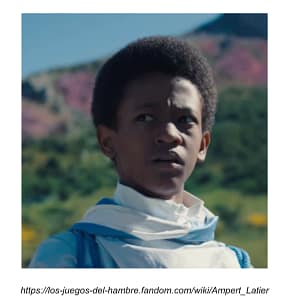
Ampert: Beetee’s Son, Not “District 3 Boy”
Then there is Ampert Latier… Beetee’s son. An Beetee has just as tragic of a past as Haymitch, yet we’d never know it without this book and movie.
We meet Beetee in Catching Fire as a Victor, a brilliant man from District 3 who survived his own Games and eventually becomes part of the rebellion against the Capitol. Sunrise gives us something Katniss never knew when she first met him: Beetee had a son in Haymitch’s Games, and not because the odds weren’t in Ampert’s favor: he is there to punish Beetee, that’s it. It underlines Snow’s malicious cruelty, brings it up a FEW levels to say the least..
He becomes part of the Newcomers and the effort to sabotage the Arena. He is one of the Tributes actively fighting against the thing the Capitol built for them rather than accepting the role they were assigned.
That gives Ampert a purpose of his own while also completely changing the emotional weight Beetee carries into the story we already know.
One of the Tributes Haymitch watches die in the 50th Games is still affecting someone Katniss meets 24 years later.
The cannon ends Ampert’s life, but it will never end his importance.
And for me, Ampert belongs right there with Louella, Lou Lou, and Wyatt as one of the saddest characters in the book.
Wellie: “District 6 Girl” Until She Isn’t
Then there is Wellie, one of the youngest Tributes, from District 6 — one of the Districts Collins has always kept relatively vague and definitely not one we associate with producing Victors.
Out of 48 children, Wellie makes it to the final three, which is pretty insane considering she’s only TWELVE YEARS OLD. She was selected in the very first year she was eligible for the Reaping and still manages to survive 45 other Tributes before getting one of the most horrific endings in any of Collins’s books: Silka beheads her, leaving Haymitch and Silka as the final two.
And by then, she isn’t “the little District 6 girl.” She is Wellie.
That matters because she is exactly the kind of character who could have disappeared into the background of Katniss’s Games: a young Tribute from a District we barely know, one of dozens of kids running around an Arena as literal cannon fodder. Collins makes her survive long enough that we have to stop thinking of her that way.

Silka Is Not the Villain
Silka deserves the same consideration.
She beheads Wellie. She becomes Haymitch’s final opponent. But that does not turn her into the villain of the story.
She is still another child inside the same machine.
The Capitol has told every one of these kids that there can only be one person left standing. By the time Silka and Haymitch are the final two, they have both spent the Games being pushed toward exactly this moment.

Snow wants an opponent, the audience wants someone to root against, the edit needs a story… but Silka is still a Tribute.
That distinction matters. The Capitol wants us to see enemies because enemies make better television. Collins keeps making us see THE children, not the MANUFACTURED show Snow has turned The Games into.
And What About Everyone Else?
Then there are Buck, Hull, Chicory, Panache, Maritte, Ringina, Kerna, Clayton, and the rest of the Tributes.
I don’t need every one of them to get a 50-page backstory. With 48 Tributes, that book would get long enough for Stephen King to tell Collins to rein it in, but they need something.
A name, a face, a personality, a relationship, a choice, a moment that belongs to them, because “48 Tributes” is incredibly easy to process: it’s a number… buuuuut, forty-eight actual children is harder to wrap your head around.




And the fact that the Capitol can then take those 48 children, edit what happened to them, move events around, cut context, and feed Panem their, NOT the Tributes’ true stories, makes knowing them even more important… and more tragic. The Capitol turns Tributes into characters in its version of the Games.

Picture Credit: Tributes compete in ‘The Hunger Games: Sunrise on the Reaping’.Lionsgate
And this is why I care so much about these new EW images. Not because I finally get to point at Mckenna Grace and yell, “OH, THERE’S MAYSILEE!”

Mckenna Grace as Maysilee Donner in ‘The Hunger Games: Sunrise on the Reaping’.Murray Close/Lionsgate
They are our first real look at whether Sunrise on the Reaping understands that this cannot just be The Haymitch Movie.
Of course Haymitch is the center of the story.
But Haymitch’s story is these people.

Louella matters because of what losing her does to him. Wyatt matters because Wyatt himself is worth caring about before Haymitch has to lose him. Maysilee matters because she becomes Haymitch’s ally and because her influence reaches all the way to Katniss. Ampert matters because his story belongs to him AND changes the way we understand Beetee. Wellie matters because the kid who could have been forgotten as “District 6 girl” makes it all the way to the final three. Silka matters because being the last person Haymitch has to kill does not make her less of a victim of the Games.
And Buck, Hull, Chicory, Panache, Maritte, Ringina, Kerna, Clayton, and everyone else matter because the second the movie turns them into interchangeable bodies, it starts doing exactly what the Capitol does to them.

Ralph Fiennes as President Snow in ‘The Hunger Games: Sunrise on the Reaping’.Lionsgate
We Never Really Knew Haymitch Either
And that circles right back to Haymitch, because we didn’t really know him either.
We knew the drunk mentor, the sarcastic asshole who fell off a stage, and the man Katniss slowly realizes is a hell of a lot smarter than he initially appears. But we knew him through Katniss. We knew what 24 years of trauma looked like without knowing most of the people attached to it.
Sunrise on the Reaping gives us the boy underneath that man, and it gives names, personalities, families, and histories to the people the Capitol later cuts into its own version of his story.
Twenty-four years after his own Games, a District 12 girl with dark hair and a braid stands in front of Haymitch, and he calls her sweetheart.
Now we know that word belonged to someone in his Games first.
That is brutal enough by itself, but Haymitch has also spent those 24 years mentoring District 12’s Tributes, which means he has spent 24 years watching another two kids walk toward the same thing that killed the other 47 children in his Arena.
Then Katniss and Peeta arrive, and he keeps both of them alive.
Haymitch’s Quarter Quell is built around doubling the number of Tributes the Capitol gets to take. Twenty-four years later, Katniss and Peeta force the Capitol to accept two Victors from the same District.
And Haymitch sits directly between those two moments.
He knows exactly what it looks like when the Capitol changes the rules because it wants a better show. He knows what it looks like when the Capitol takes what happened and turns it into the version Panem is supposed to believe. And he knows what happens when the Tributes stop behaving according to the roles the Capitol wrote for them.
That is another reason the other 47 cannot be scenery in this movie.
We already know Haymitch wins.
That is not the suspense.
The tragedy is finally understanding who was standing beside him before he did — and how much of what Panem thought it knew about those Games was shaped by the people controlling the cameras.
For years, they existed as pieces of Haymitch’s history. Now Louella gets to be Louella. Lou Lou gets to be more than a replacement. Wyatt gets to break my heart properly. Maysilee gets to be more than a Mockingjay-pin footnote. Ampert gets to be Beetee’s son and his own person. Wellie gets to be the little girl from District 6 who made it to the final three. Silka gets to be more than the last obstacle standing between Haymitch and victory.
And the rest of the 48 get the chance to become something other than numbers on a board — or whatever version of them survived the Capitol’s edit.
Haymitch walks out of the 50th Hunger Games alive, but he does not walk out of them alone. He carries those kids with him for the next 24 years, all the way to another District 12 girl with a braid, another boy beside her, and one more chance to get his Tributes home.
The Capitol only needed those children to fill roles in its show.
Then it got to edit the show.
Collins gave them names, identities, and their dignity back.
Entertainment Weekly’s new images are finally giving us their faces.
All affiliated links attached.
Now the movie has to give them back the story the Capitol took from them.
Let’s hope it’s as good as it looks!
*K
Source Article: https://ew.com/the-hunger-games-prequel-sunrise-on-the-reaping-cover-story-exclusive-12066866


