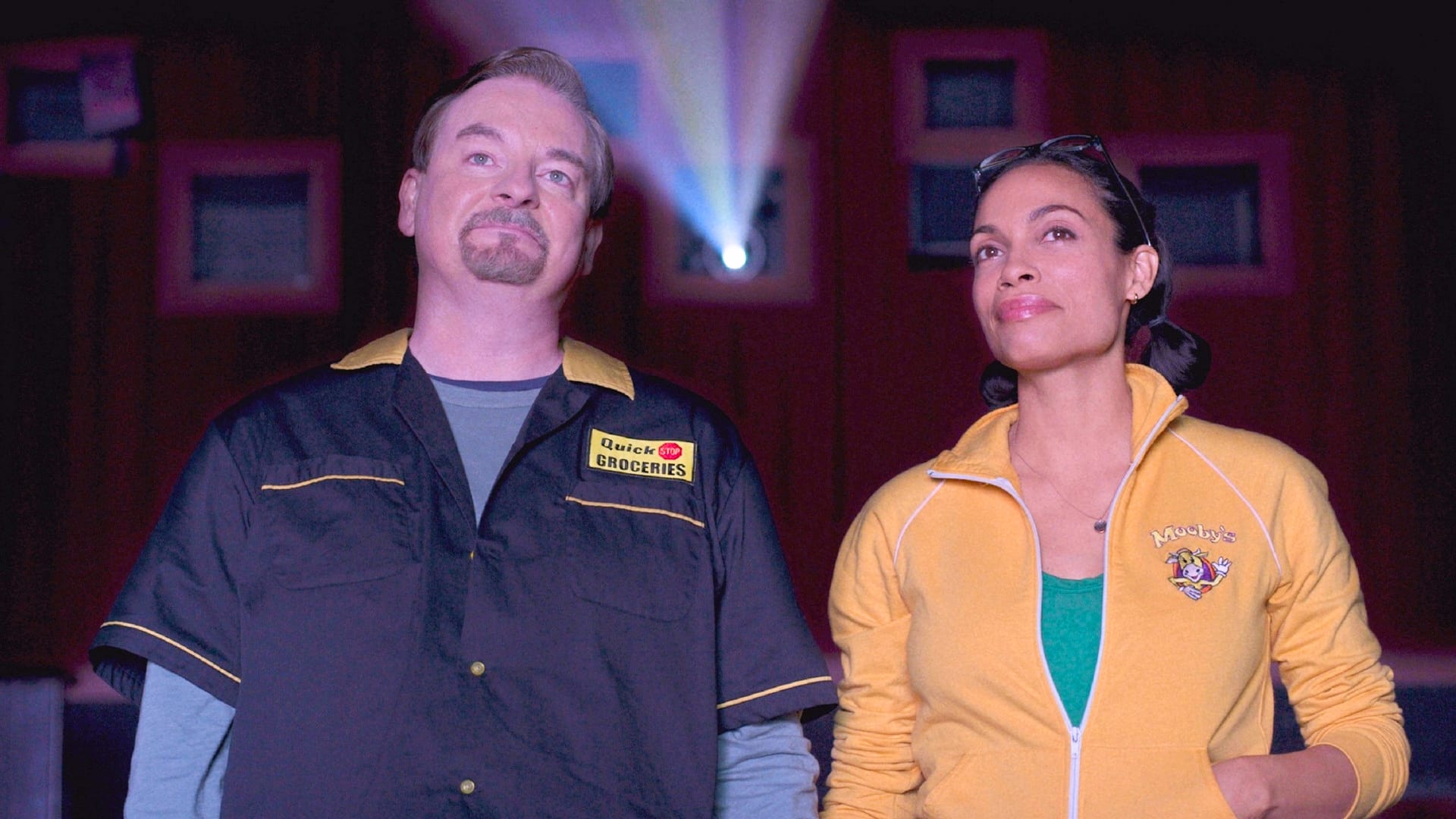
When director and podcaster Kevin Smith revealed his plans to bring Clerks III to the screen, he said he did it because he wanted to reward the characters who made his life so rewarding. This motivation promises a very different movie than we actually get. Which is to say, the film is not a series of great-but-funny things happening to the ol’ Quick Stop gang. Instead, this movie examines mortality in a way one doesn’t expect in a film with “Clerks” in the title. This film is rewarding for the characters and the audience. Yet, unlike Jay and Silent Bob Reboot, this is not a film where every character gets their happy ending. In what some believe to be the hallmark of a truly great movie, Clerks III ends on something of a down note.
The very end of Clerks III actually reminds me a bit of the final sequence in The Wire. It’s both an ending, a new beginning, and symbolic of an ongoing cycle hidden in plain sight in American life. Unlike The Wire, however, Clerks III’s cycle is not one of violence, pain, and a futile drug war that only serves to sustain itself. Even though the director’s postscript to the movie promises at least one really happy ending, the cycle that repeats at the end of this story is simply one of life going on. People stepping into roles, both professionally and personally, that others occupied before them, and others will occupy when they are gone. The subtle message of Clerks III is that a movie is not great because of the filmmaker, but rather because of the subject matter that inspires it. The movie that Randal makes is not the greatest movie Dante ever saw because Randal was great at the job. It was because he, like so many Americans in “menial” jobs, got to see his life portrayed like it was something important, something worth seeing.
Clerks III highlights Smith’s Growth as an Artist
Clerks III is a movie that is funny and heartfelt in equal measure. The trailer for the film laid the premise out almost as a warning to viewers and critics who think Smith — one of the original self-referential filmmakers — is too self referential. In this film, Randal (Jeff Anderson) sets out to make his own movie, and that movie looks a lot like Clerks (1994). There is a moment, near the end, where actual footage from Smith’s first film plays. (Without getting into spoilers, there is a reason this works as well as I promise you it does.) However, the film does not turn into a Clerks clip show. In fact, it probably only barely resembles what it looked like when Smith filmed his first movie while actually working at the convenience store. Yet, for perhaps the first time on film, Smith gets to draw on what “Young Kevin” experienced making the first movie.
One of the most common complaints about Clerks III in other reviews is more telling about the reviewers than the filmmaker. Some people find it unbelievable, or simply “sad,” that both Randal and Dante are still at the Quick Stop. (People seem to forget they are co-owners of the business after Clerks II.) Yet, I can go to any of the two diners left in the town I grew up and be served by people who worked there when I was in high school. In fact, the entire View-Askewniverse, and Jersey Girl, are about regular folks who don’t have enough money that they never have to worry about bills or where to get $30,000 to make a movie. The Clerks films especially, even for as delightfully silly as they can be, implicitly suggest that the lives lived by blue-collar/service industry folks are just as important and entertaining as the lives of the people normally put in Big Hollywood Feature Films™.
Smith, like myself, is a huge fan of Neil Gaiman’s The Sandman comics, now a show on Netflix. A story from the comics, “The Sound of Her Wings,” was adapted for Episode 6 and given the same name. The majority of the episode is actually the story of Morpheus (Tom Sturridge) and Hob Gadling (Ferdinand Kingsley), but the first bit is the story where Dream follows his sister Death (Kirby Howell-Baptiste) around as she collects souls. During one of her encounters, the man she is meeting bemoans that he didn’t have enough time. Death responds that he got what everyone else gets: A Life. Yet, as Dante (Brian O’Halloran) said during Clerks’ infamous Star Wars scene, a “life is a series of down endings.” And, despite the saccharine sweetness of Jay and Silent Bob Reboot, Smith remembers this is Dante’s worldview. The character’s series of down endings continues. There is a moment in the film when Dante leaves a movie before he sees the ending. The implication being that his time focusing on the down notes has ended. He goes off-screen not into the sunset, but another bright light filled with promise: the warm glow of a movie projector.
Loss and Legacy Weigh Heavy In This Final Clerks Film
If the past five, or so, years have taught us anything, it’s that the down notes never stop. From a president whose corruption is only outmatched by his incompetence to a once-in-a-century-pandemic (that is still going strong at the time of this writing) to what seems like a social and political system ill-equipped to seriously address any number of urgent crises, life is fucking hard. But it’s also glorious and magical and better than any other alternative, real or imagined. That’s what’s being celebrated in Clerks III. Kevin Smith isn’t “sucking his own dick for two hours” (though rumor has it you can see that if you get a high-enough tier at That Kevin Smith Club). Instead, Smith is asserting that Randal’s and Dante’s lives are important and worthy of being immortalized. Not only do titles not determine behavior, they also don’t determine someone’s worth.
Looking at them uncharitably, Randal and Dante are losers. All they do is complain and whine about their menial lives and wouldn’t be missed by the world if they were dusted like Thanos just snapped his fingers. Some other schmoes would step into their wage-work jobs and the world would spin on. Yet, if this is how you see these characters, I’ve have bad news you for you: you’re an asshole. Clerks III is, as the director said, a “life-affirming” movie. One of the ways it does this is by affirming the menial lives lived by these characters making jokes, knocking over coffins, getting busted at donkey shows, and making a movie, are lives with meaning. Dante and Randal remind me of people I grew up with, including those I went to school with who might ring me up at the drug store or take my order at the hometown diners. This film celebrates lives like that, lives some might call “uninteresting” or “unfulfilled,” and shows us all that the fulfillment comes not with success but rather chasing some passion with the people important to you at your side. This film also celebrates, in its own way, that any one of us can hear the sound of her wings at any moment. Clerks III is about looking at the life we got not with regret but the gratitude such a miraculous gift deserves.
I started this review of Clerks III by comparing the end of the film to The Wire (and will probably remain the only person to do so). The final sequences also have an almost Lynchian dreamlike quality about them. A character runs somewhere on foot in the dark. Two characters meet again, and interact in way they hadn’t yet in the movie. A character returns in the last moment, the meaning of this uncertain but ending the film on a powerful (yet familiar) image. Well, your mileage may vary about how powerful it actually is. So, if you enjoy Patrick H. Willems videos you’ll likely find it all so very pedestrian. But that’s the fucking point. Clerks III is about the invisible lives of the people around us. Just because someone doesn’t start a war or a business or have a half-dozen kids, they still have legacy. They become a part of the fabric of where they lived, so long as people remember them. Their drama is big. Their laughs are big. And their dreams are just as real, and just as in reach, as they are for anyone able to amass the will and resources to pull them off.
Clerks III resembles the first film in one way that no one is talking about. It’s the sort of film that can make someone else feel like they too could make a movie. Is there any better art than the kind that inspires more art? There is every chance, so long as Kevin Smith keeps making movies, shows, and comics, that the Clerks could return. Yet, Clerks III has a finality to it that feels rare in the connected-universe of Smith’s filmography. Even scarier than death, at least in fiction, is the story coming to an end. That has such a finality to it that it can seem frightening to the creator, especially because it feels like turning the sun off in an entire universe. But there is another way to look at it. I forget who said it (maybe Raymond Carver?), but sometimes endings aren’t the closing of a door but a window. It was open enough for us to look in and get a sense of other people’s lives, and then it shuts again and they go on living in their corner of the multiverse forever. If Clerks III is the last time the window opens on this slice of the View Askewniverse, there could be no more perfect way to do it.


