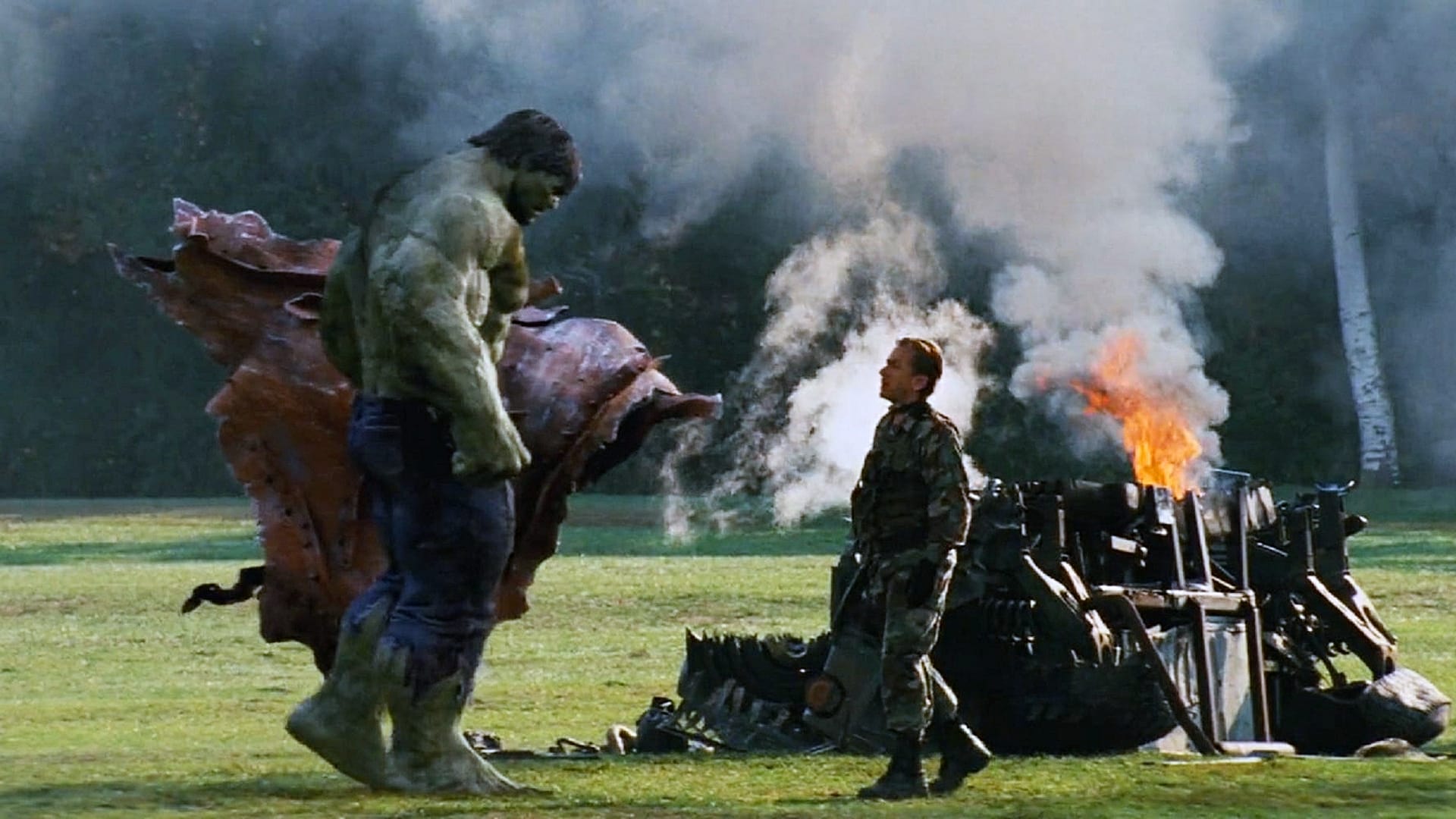
People love to rank movies in lists from “best” to “worst,” but those labels aren’t really very constructive. Yet, any such list of the 22 movies in the Marvel Cinematic Universe will invariably place Louis Leterrier’s 2008 film The Incredible Hulk near the bottom. Admittedly, this is the MCU film I’ve rewatched the least. I’m not sure, but this latest viewing might only be the third time I’ve seen the film from start to finish. It’s for this reason that I say, with no small amount of surprise, that The Incredible Hulk is actually “pretty good.” It’s certainly an improvement on Ang Lee’s 2003 take on the character, but there is no question that this film doesn’t work as well as others in the MCU. What sets this film apart from other MCU films, especially 2008’s Iron Man is that it all but ignores the most important part: its characters.
One obstacle this movie had to overcome was that, unlike other Phase One MCU films, this was not a stand-alone introduction to the character. Marvel ended up with some of the rights to the Hulk, but Universal Studios maintained distribution rights for his solo films. Thus, they wanted to it to be, at least, a spiritual sequel to their earlier effort, despite recasting all the roles. Unfortunately, this resulted in the film suffering from what I like to call Teen Wolf, Too syndrome, which happens when a sequel recasts the roles and ends up telling mostly the same story as the first film. In this case, the story is: Bruce Banner is the Hulk, he loves Betty Ross, and he is on the run from her father, the silver-haired, mustachioed General Thaddeus ‘Thunderbolt’ Ross. Edward Norton replaced Eric Bana as Banner. Liv Tyler replaced Jennifer Connelly as Betty. And William Hurt stepped into Sam Elliott’s combat boots to portray Gen. Ross.
The Incredible Hulk makes the bold move to skip past the origin story, instead offering it via montage intermixed with the opening credits. It’s very reminiscent of the TV series of the same name in the late 1970s and early 1980s, with Bill Bixby in the title role. (He gets a cameo but as his character on The Courtship of Eddie’s Father.) If this had been a true sequel to the earlier film, this could have worked. However, with all new characters in the role, the characterization suffers in favor of speedy exposition. The thing is, there is a lot of story in this movie. The movie runs about two hours, but it feels longer because so much happens in it. In a lot of cases, this doesn’t have to be a criticism. However, it is in this case, because for all the story within, there was no real soul.
In the first 17 or so minutes of Iron Man, we’d met all of the principal figures in scenes that both provided exposition and established their characters. We also experienced, twice, the inciting incident of the protagonist’s Hero’s Journey. Norton’s Banner doesn’t have a meaningful conversation with anyone until about 36 minutes into the film. The person he speaks to is a man from his past named Stanley. (That this character was not played by Stan Lee is the ultimate sin this movie commits.) Banner is very happy to see his old friend, but as the audience, we don’t know who this person is or anything about how he and Bruce are special to each other. This character is simply a signpost for Tyler’s Ross and Banner to find each other again, which they do almost immediately.
If this were a proper sequel, all these reunions might evoke an emotional response, because at least the audience would have some frame of reference for who these people are to each other. Ironically, the opening of this movie is a great example of the writing adage “show, don’t tell.” We get the gist of Banner’s life since his accident with just a few visual clues. We see the experiment in the credits, and then a quick montage of how he’s learning to cope with his anger. There are plenty of cool details throughout. For example, Banner learns Portuguese by watching a dubbed version of Sesame Street and a Portuguese-to-English dictionary. The film also shows us at how his menial day labor job, he uses his skills as a scientist to fix things around the factory. Yet, as soon as people show up, things start to fall apart.
There are a trio of bullies and a casual love-interest named Martina, played by Débora Nascimento. It’s unclear what Martina and Banner’s relationship is. They are friendly, possibly sleeping together, but it doesn’t matter because all of them are forgotten as soon as the Hulk shows up for the first time. One of the other reasons this movie isn’t as beloved as others in the MCU is that it has no idea what to do with Banner. Norton seemed to be channeling Bill Bixby in his performance. In the special features on the DVD release, Norton says the television series inspired his take on the character. He also mentioned that both he and Liv Tyler spoke extensively about who their characters were, their lives, and what drives them. Sadly, that information seems to have been internalized, because none of it makes to the screen, even as subtext. According to reports in the pop culture press, when Edward Norton came on to the film, he reportedly rewrote the script extensively. (Still, the WGA denied him a writing credit, saying he only changed dialogue.)
Now, it’s impossible to know what really happened behind the scenes of this film. However, it’s possible that the blame for this failure is not on Norton or Leterrier, but on nameless “studio executives.” According to Peter Scrietta of Slashfilm, Norton’s script included much of the characterization work the film lacks. Currently, The Incredible Hulk is the shortest film in the MCU canon at 112 minutes. Norton’s script additions supposedly would have added about 28 more minutes to the film. Famously, the first addition Norton made was a scene where he went up to the Arctic to kill himself. However, when he does the Hulk takes over and he doesn’t die. This scene lives on as a speech from Norton’s replacement in the role, Mark Ruffalo, in Avengers. To hear his replacement recount a scene he wrote must have been particularly tough for Norton. Perhaps, that’s why he still feels salty about the whole experience.
Before we talk about the other major problem with this movie, specifically how it worked to set up a sequel that obviously never happened, let’s talk about what does work. Despite all of the problems with character, William Hurt and Edward Norton do great in their respective roles. Hurt reprised his role for later MCU films, but his involvement is tantamount to a cameo. Still, he plays an incredible bastard. Ross is ruthless, obsessed, and (at times) overwhelmed by the situation he finds himself in. Norton offers up a muted performance as Banner, but this makes sense as he’s a man trying to keep his emotions in check. Tyler does the best she can with Betty Ross, but she doesn’t seem to be given much to work with. Essentially Betty’s role is to A) Love Bruce Banner no matter what and B) Be the scientist in the room when Banner is otherwise unavailable. Oh, and she also is there to pawn a necklace given to her by her mother (we assume?). Even in the deleted scenes, Betty is a character that only exists to exacerbate the tension between Ross and Banner.
Despite all this, The Incredible Hulk is an entertaining movie and contains a number of impressive action sequences. The entire portion set in Brazil was fun to watch, and arguably the most informative scenes about Bruce’s character in the film. In fact, any time that the Hulk was on-screen, it was exciting and worth watching. A marked improvement over 2003’s bright-green, almost-cartoonish Hulk, this version of the character looked and felt like the actual comic book Hulk come to life. The fight with Ross’s forces on the Culver University campus and the final fight between Hulk and a fully-mutated Abomination was great. Also surprising was the fact that the Abomination is apparently still alive, since Betty stops the Hulk from killing him.
Tim Roth’s performance as the human half of the Abomination, Emil Blonsky, is hands-down the best in the film. His journey, as a balls-to-the-wall spec forces soldier hungry for power, reminded me a little of Michael B. Jordan’s Erik Killmonger. Blonsky didn’t want the power to avenge racial injustices or anything like that, but the two seemed to be cut from a similar cloth. It’s a big Army, but part of me likes to think that Blonsky trained with young Eric at some point. One has to wonder about the quality of the script Zak Penn submitted before Norton got his hands on it. Assuming that Norton didn’t tweak scenes his character was not in, Penn’s skill in crafting the dialogue was good at offering up both exposition and the kind of character moments this film lacked. It’d be strange, but I hope they bring Roth and the Abomination back for Phase 4. There was a lot there left to be explored, and every time we left Blonsky to go back to Bruce and Betty, I was sorry.
If the scenes included on the bonus features of the DVD were the ones cut from Norton’s additions to the film, they still really didn’t deliver the sort of character work we needed. Still, they would have been a much better inclusion than the entire Samuel Stearns/The Leader subplot that served only as “schmuck-bait” and set-up for the next Hulk movie that never came. The goal from the get-go was always to get to the Avengers movie, so it’s always a safe assumption that Banner would not be able to cure himself. Yet, we are forced to endure laptop-chat scenes and a fake-out “cure” scene, the result of which was spoiled by the theatrical trailer. It didn’t serve the larger story. Ross and his cronies could have found Bruce and Betty any number of ways. Blonsky could have become the Abomination just from Ross’s treatments alone (which would make more sense as to why no one other than Blonsky tried out that version of the super-soldier serum). This is a good lesson for franchise films to follow: don’t worry about setting up the next movie, just worry about making the current movie as good as it can be.
I opened my piece about Iron Man by pointing out how it could have been a disaster. What made the film work, it seems, was that a lot was asked of everyone involved and they came together to deliver something amazing. My impression is The Incredible Hulk was what it looks like when in the face of such an “ask,” those involved don’t deliver. This is a pretty good movie, but it’s definitely one where you find yourself counting down the moments until the next time the Hulk or Blonsky shows up. The characters at the heart of it, Betty Ross and Bruce Banner, failed to land with audiences in the way that Robery Downey Jr.’s Tony Stark and Gwyneth Paltrow’s Pepper Potts did. It was a bold attempt, and it succeeded where it needed to: making about $20 million more at the box office than Ang Lee’s film did. Yet, this film’s legacy is to be, forever, at the bottom of the “Best/Worst of the MCU” lists.
Of course, it’s got some company at the bottom of those lists, and our next film is one that usually joins it. Iron Man 2 was an attempt to go bigger and bolder than they did on the first one. Whether it succeeded or not, we’ll find out. That movie introduced the new Rhodey, Don Cheadle replacing Terrance Howard (who says it was over money). Of course, that’s not the biggest role that’s been since recast. After the drama over the making of this film, Edward Norton stepped away/was asked to leave, with Mark Ruffalo later being cast to play Banner and the Hulk.


