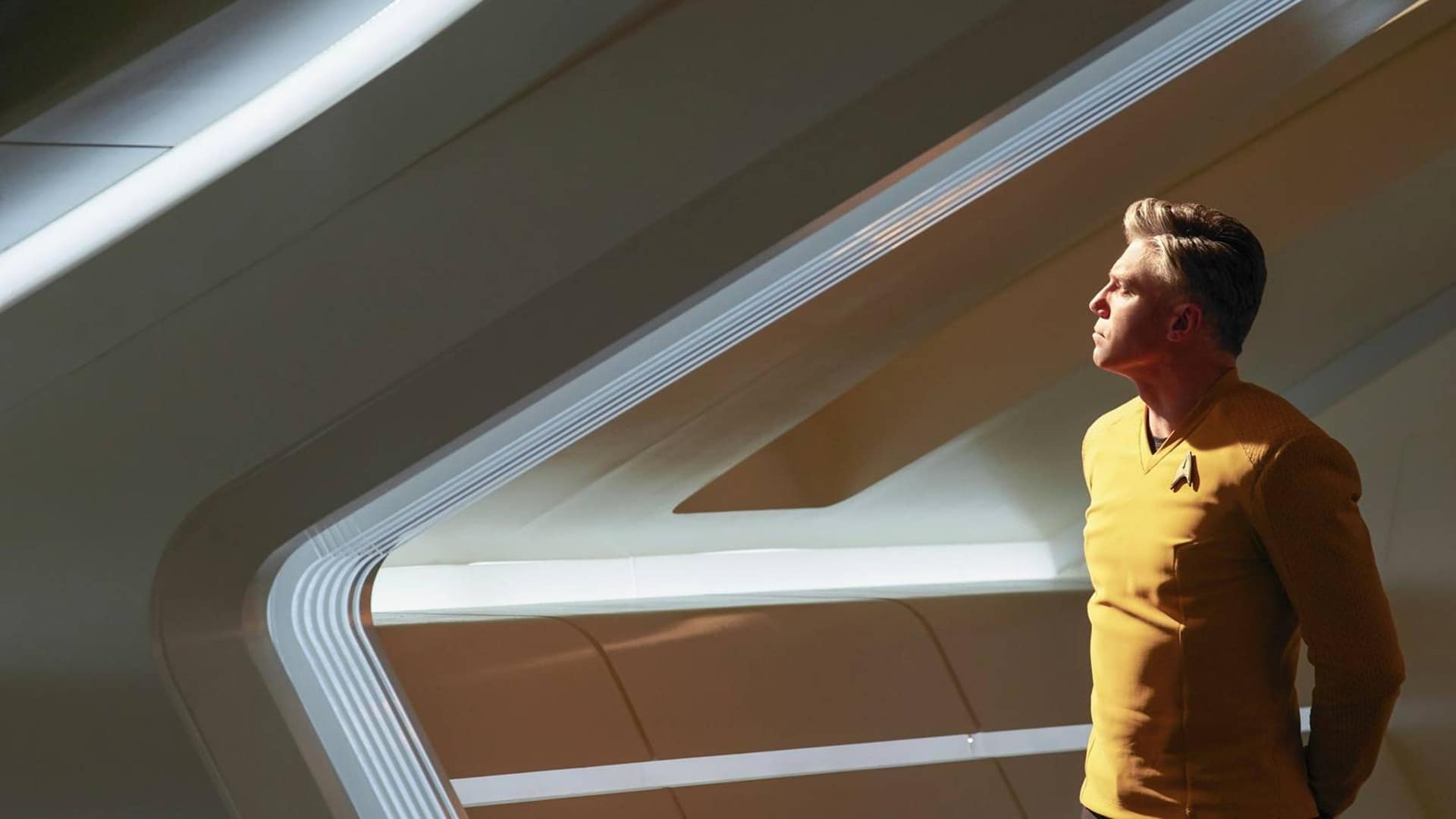
A little more than a dozen years ago, J.J. Abrams told the world he was going to be taking his talents to Star Trek. It had been a few years since the last of the “Next Generation” series went off the air. (The criminally underrated Enterprise, or the one with that theme song.) Since then, we’ve gotten a lot of Star Treks: Discovery, Picard, Lower Decks, Prodigy, and Short Treks. These series tell different sorts of stories, strike different tones, and have made Star Trek a fresher and more diverse franchise than ever. Yet, with Star Trek: Strange New Worlds, we are all finally getting the show we wanted. A bunch of pretty people on the USS Enterprise exploring space week to week, getting into scrapes, being brave, and giving speeches. Looking to the stars and making the folks at home feel like the future is bright and exciting.
Akiva Goldsman and company have finally cracked the code to how to do that given the tumultuous state of Trek fandom at the moment. Fans of things with “Star” in the name usually can always find something to complain about. That said, Strange New Worlds feels like it could be a phenomenon from back in the 1990s glory days. While this could be said about all of the new Trek installments, this is a series that truly is for the hardcore fans and someone who’s never seen a “Star” anything before.
Strange New Worlds Balanced Serialization and Episodic Storytelling
Both Picard and Discovery are heavily serialized shows. Sure, they have a “mission of the week” in each episode, but almost all of it is tied to a larger story arc. Strange New Worlds has these elements, but they are tied to characters. Like the animated series over at Star Wars, longtime fans enter this story knowing everyone’s fate. Even the new characters. Well, at least, we know where they weren’t once James T. Kirk captained the Enterprise. What happened is already foretold, right? So, how or why it happened becomes the more interesting story to the audience.
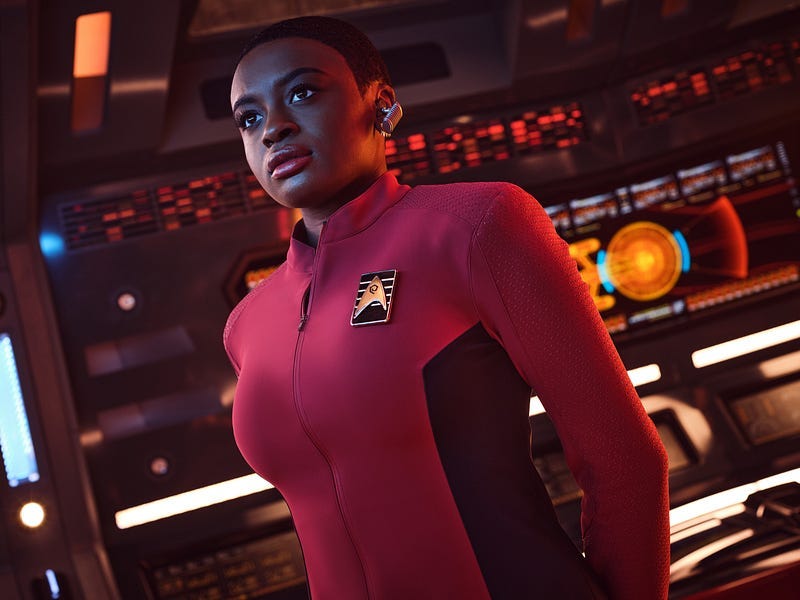
Celia Rose Gooding has the daunting task of playing one of my favorite characters in all of Trek. Taking the baton from Zoe Saladana, she plays Nyota Uhura, at this point a cadet assigned to the Enterprise. She also has the daunting task of acting in the shadow of Nichelle Nichols, who was so important to Star Trek, even Martin Luther King, Jr. noticed. Gooding’s Uhura is closer to Saldana’s in that we meet her before she is the competent communications officer that she is in Star Trek: The Original Series.
Yet, this Uhura is still facing a crisis of faith that we’ve not seen in the character before. Again, we know where she ends up. How she gets there is what interests me as a longtime fan. Yet, the show is also perfectly acceptable to viewers who might say something like: “Oh no, I sure hope Uhura stays on the Enterprise!”
Ethan Peck is back as Spock, and the events of Star Trek: Discovery are not discounted. Yet, for folks who found themselves unable to connect with that story, the first few episodes tell you all you really need to know about it to enjoy Strange New Worlds. Arguably, he has the most difficult job of anyone on the cast. So much so that when Pittsburgh native Zachary Quinto took on the role, Abrams was kind enough to let Leonard Nimoy be an older version of the character in the movie.
Peck not only had to navigate the inseparability of Nimoy with this character, but also the big canon addition that Sonequa Martin-Green’s Michael Burnham was his foster sister. I admit to even sighing a little at that myself, just because it gives off “small world galaxy” vibes. But, Peck and Martin-Green turned me into a believer. With this, Spock’s desire to be more Vulcan than Human takes on a deeper, more tragic subtext.
Star Trek’s ‘Number One’ Finally Gets a Name and a Backstory
Another character who appeared with Peck both on Discovery and in a Short Treks episode is Rebecca Romijn as Number One, Magel Barrett’s character from the unaired Star Trek pilot (later repurposed as “The Cage”). The original series we got does seem preferable to the first version. Yet, Barrett’s relegation to Nurse Chapel rather than second-in-command feels like a loss. So, it’s great that Romijn gets to give this character her due. (Also, I think they are somehow using the late Barrett’s voice as the Enterprise computer, and while it may be ghoulish it warms this Trekkie’s heart just to hear her again.)
Still, Una — a very clever name for Number One — is a fascinating character. The series expands the Star Trek lore with her in a big way. While she looks like just another human member of the crew, her appearance may be deceiving. Yet, as established in Discovery, both Captain Pike and Spock are very loyal to her and she to them. In fact, the premise of the pilot episode involves Number One caught in a cage and needing rescued.
Strange New Worlds Brought Back Other Deep-Cut TOS Characters
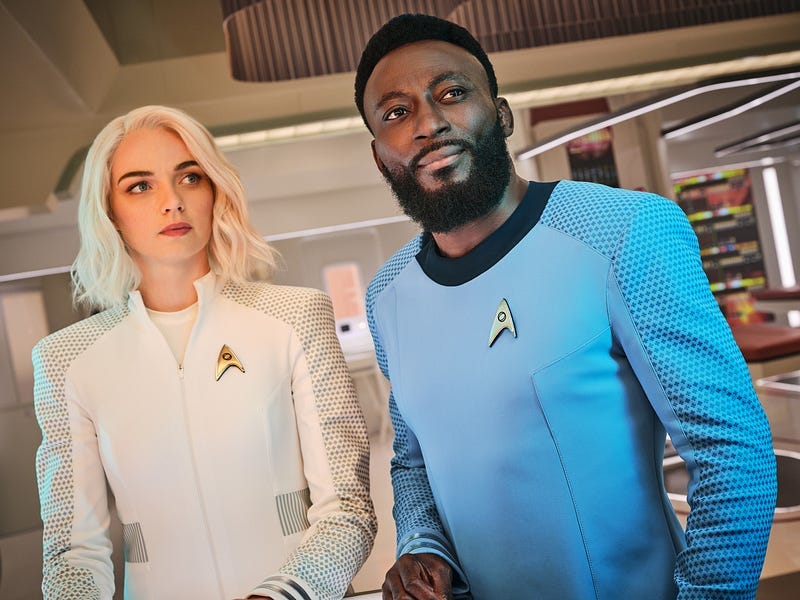
Strange New Worlds also brings back a Star Trek: The Original Series character in Dr. M’benga, originally played by Booker Bradshaw. Perhaps most famously known for slapping the dog spit out of Spock in the second season episode “A Private Little War,” to snap him out of his “Vulcan healing state.” The character appeared in other episodes, including an unproduced script that dove into his backstory as a man from Uganda with a brother serving as First Officer on another vessel.
Babs Olusanmokun will take the baton from Bradshaw, bringing this character to life again as the Chief Medical Officer on the Enterprise. Now, some fans might wonder why Dr. M’Benga would still be on the Enterprise after Leonard McCoy is named CMO under Kirk, but this series offers an interesting character detail that could explain that. Yet, in the timeline of the series, we’re at least five years out from Kirk’s command, so it will take some time for this particular issue to be resolved.
Anson Mount Is Star Trek’s Best Version of Captain Christopher Pike
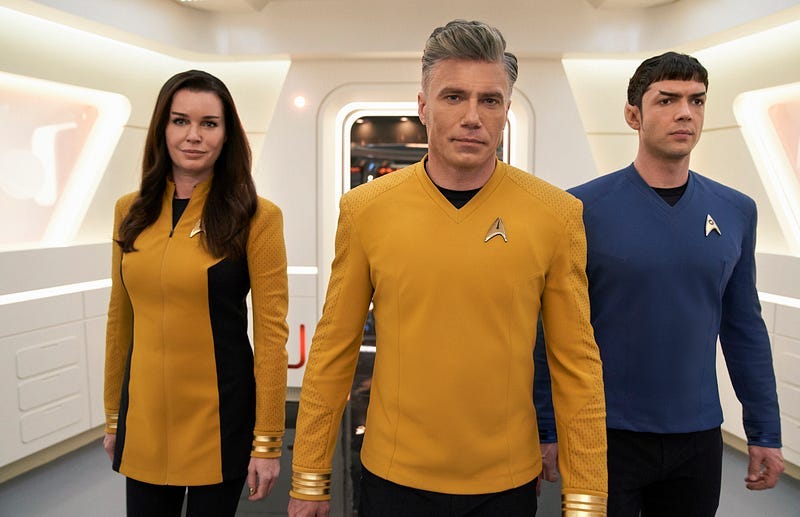
Anson Mount, who’s last attempt at the world of franchises was the ill-fated Inhumans TV series Marvel Studios would rather we forget. While that show did have its issues, Mount was not one of them. In fact, he faced the added challenge of having to play a leader who could not speak. When he showed up on Discovery as Pike, it was just the energy that show needed. One thing some Trek die-hards might say is that he’s a bit too much like Kirk. Yet, the differences are as plentiful as the similarities, and Pike’s role in the now-expanded Star Trek franchise is to serve as a kind of proto-Kirk.
Pike is a fantastic Captain, but he doesn’t really seem to do much other than care a great deal about his crew. There are a lot of strong characters, all who get their moments in the sun (sometimes literally). Also, Pike was very heroic in Discovery, as Burnham’s ally in trying to save Spock that season. Lastly, the idea that Pike is a hero is not ever in question. A big part of his arc relies on it, in fact. Still, I’d like to see the Captain come to the rescue of his crew, just because it sells the notion that these people are loyal enough to him to face certain death. Yet, in these first episodes the storytellers want to give the rest of the crew time to shine.
Mount’s performance is such that, even as a die-hard who respects the idea of “canon” story events, I hope this version of him gets to cheat the fate that awaits him in “The Cage.” Yet, even if it doesn’t, it means we could have (at least) 10 or so seasons of this series, and I’d take every second of it. That both we (and the character himself) knows his ultimate fate obviously adds a new layer of pathos. In fact, one might expect that like the other Paramount+ Star Trek series, Strange New Worlds would lean into that heavy drama. Instead, it enriches our understanding of the character when he seems to be having fun in very not-fun situations.
Strange New Worlds Brought ‘Fun’ Back to Live-Action Star Trek
Shore leave or meetings, life-or-death battle or sci-fi hijinks, Pike gets exhilaration from feeling alive. Kirk and the other Captains were hopeful because, well, they are Star Trek captains. Pike is hopeful and inspiring in spite of, technically, having no real hope. This show takes the classic Star Trek formula, and upgrades it from all sides.
The show Ted Lasso surprised me in a lot of ways, but mostly because it challenged a long-held belief I had about fiction and drama. Basically, that if you have a bunch of characters who are all just nice to each other, there is very little interesting drama. Strange New Worlds has that same quality, just in an action-adventure space exploration show. There is interpersonal tension in the crew and constant threats from boldly going where no one has gone before.
Yet, this crew feels like a real crew. There is one exchange during a very fierce conflict episode between Pike and Spock that does more to establish their mutual respect and friendship than the entirety of Star Trek (2009). It’s a truly classic exchange up there with “The needs of the many outweigh the needs of the few.” & “Or the one.” It doesn’t just feel like Star Trek, Strange New Worlds is unmistakably what people think of when they think of this franchise.
To be completely clear, Star Trek: Discovery and Star Trek: Picard are also hopeful and satisfying shows. They tell ambitious, complicated stories with sci-fi and metaphysical concepts used as allegory to directly reflect real-world sociopolitical issues. They are also stories focused intensely on the characters and their growth, meaning they constantly change. Where you could probably watch Star Trek: The Original Series in any order and still understand it, these new series aren’t that. And that’s good. Telling epic stories like this are exactly what Star Trek is for, and a service like Paramount+ is the perfect place to do it. They shouldn’t have to fight for ratings week-by-week nor deal with the tight production times (or budgets) of the Trek shows of old. When Strange New Worlds finishes its third season, all of a sudden, you’ll be seeing Trekkies and critics circle back around and realize what a dynamic gift these shows have been. They are hopeful stories, and in them the characters must fight and suffer to find it.
Strange New Worlds Gave Fans a Break Without Selling the Stories Short
The thing that makes Strange New Worlds different and a bit of a relief is that neither character nor viewer has to fight too hard to find the hope in it. They wear it on their sleeves like the Trek shows of old. This is an easy show to watch, and it wants to make you feel good. The only thing that separates this series from the ideals of the first one, is that Strange New Worlds isn’t nearly as horny as the 1966 series. It’s hornier than its modern contemporaries that’s for sure, but it lacks the near-constant flirtations from The Original Series, which ultimately is a good thing. Still, horniness is as much a part of Star Trek’s DNA as are warp drive and phasers.
While there are going to be clearly inter-connected character stories and arcs for the season, much of Strange New Worlds is episodic. Each week, the Enterprise crew encounters a new problem in a new place, and they have to do their best to solve it. It’s what made every iteration of Star Trek from the Original Series to Enterprise so much fun to watch. You get to know the characters, understand them and even watch them grow. But you can still just jump in once a week for an hour for an uplifting adventure with some space pals. While I personally love everything that has been done with Star Trek in the past dozen or so years (except the Khan fake out, that was wack), Strange New Worlds is like the payoff of that emotional investment. Discovery, Picard, Lower Decks, and Prodigy all have proven that Star Trek is a franchise capable of telling stories with a different tone than what came before. Strange New Worlds is a return to form, and allows us to get the kind of Star Trek stories we’ve missed for more than a decade with big, cinematic VFX.


One Comment on “Review: The First Season of Strange New Worlds Was the Star Trek Everyone Needed”